

“They asked her, “how did you free yourself?” She answered, “by embracing my own power.”
🖤A Note from Me
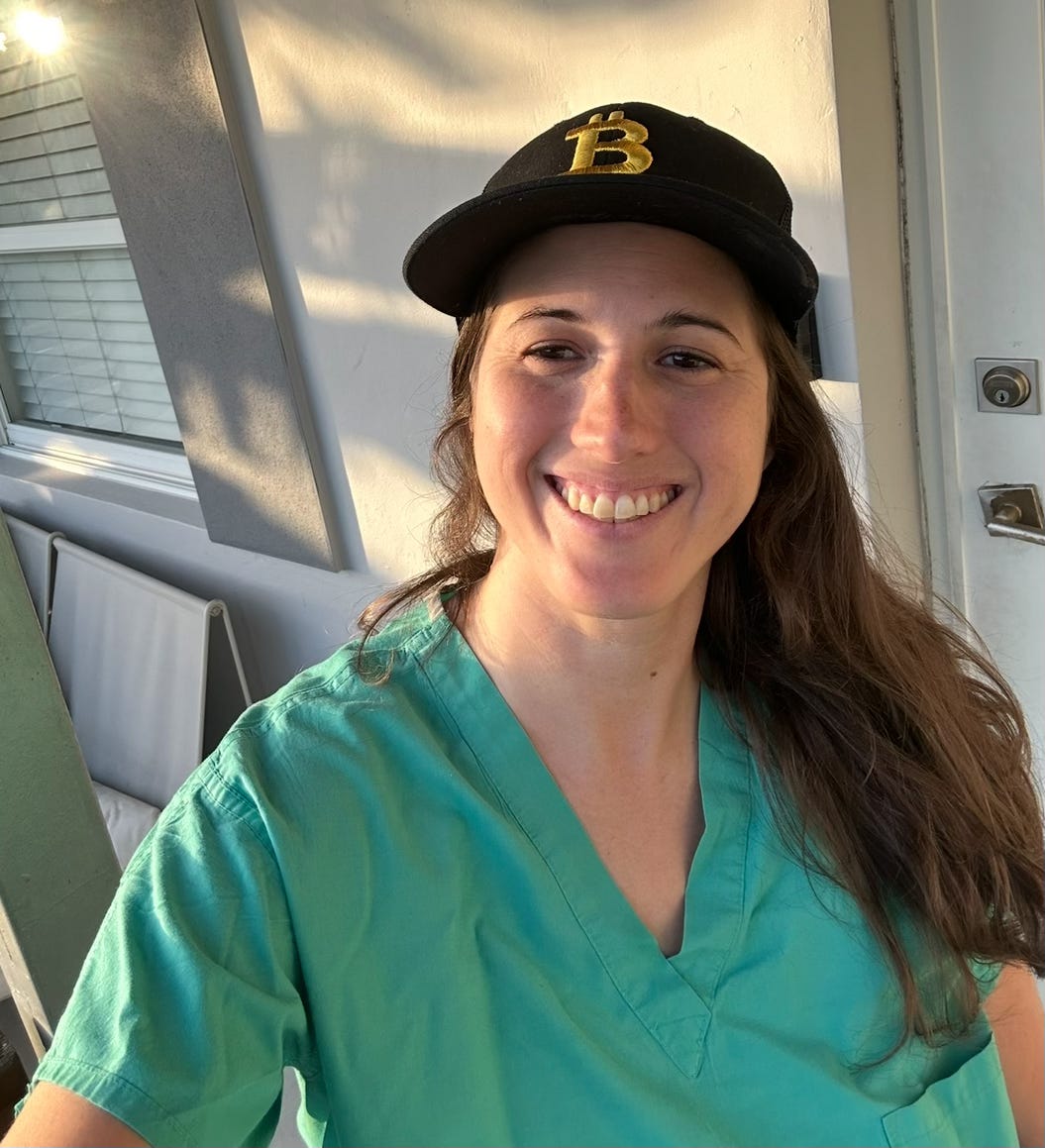
Hi, I’m Jessica.
I write NP Fellow, a weekly mental health and functional medicine newsletter, to help readers gain emotional steadiness, achieve optimal health and emotional freedom, and become the C.E.O. of their own health.
I’m a nurse who loves health and wellness, a self-taught stock trader of the last five years, and someone who grew up playing competitive travel ice hockey.
🚨My new NP Fellow paid series called the Weekly Skill is now live and will be posted every Wednesday!
For readers who want practical tools to build emotional regulation skills week by week, I’ve created The Weekly Skill—a structured training system for developing self-trust, nervous system stability, emotional steadiness, internal validation, and psychological flexibility.
🌀 NP Fellow Sunday articles and deep dives will always be free. If you’d like to support this work and access The Weekly Skills, upgrade here.

The CEO Skill That Matters Most: Sitting with Uncertainty Without Spiraling
I was sitting in my car outside the clinic, staring at the paperwork in my lap.
Two treatment options. Both made sense. Both had research behind them. Both came with risks I couldn’t predict.
My doctor had walked me through everything—patiently, thoroughly—and then said the words that made my stomach drop: “It’s really up to you.”
I wanted her to tell me what to do. I wanted certainty. A clear right answer.
Instead, I got ambivalence.
And I felt like I was failing at being the CEO of my own health because I couldn’t make the “right” choice.
The truth is, there wasn’t one.
There were just two reasonable options sitting in front of me, and my brain was screaming at me to pick the perfect one.
That’s when I realized: the skill I actually needed wasn’t better research or one more expert opinion.
I needed to learn how to sit with not knowing without spiraling.
The Problem with Certainty-Seeking
When you’re the CEO of your health, you’re signing up for more than just green smoothies and annual checkups.
You’re accepting responsibility for decisions that don’t come with guarantees.
The research is conflicting.
One expert says hormone replacement therapy is essential.
Another says it’s dangerous.
Your labs are borderline.
Your symptoms are real, but your diagnosis is unclear.
Most of us respond to this uncertainty the same way: we spiral.
We research obsessively.
We seek one more opinion, hoping someone will finally tell us the right answer.
We freeze and avoid the decision entirely.
The problem? We’re treating ambivalence like a problem to solve when it’s a reality to tolerate.

What Your Brain Does with Ambivalence
Your brain is wired to resolve uncertainty as fast as possible.
The anterior cingulate cortex (ACC) lights up when you’re faced with conflicting information. It’s the part of your brain that detects conflict and screams, “We need to fix this now.”
When you can’t resolve that conflict quickly, your amygdala joins the party.
That’s your threat-detection system.
It interprets uncertainty as danger.
Your nervous system shifts into fight-or-flight mode, which is why sitting with “I don’t know yet” feels so physically uncomfortable.
Meanwhile, your prefrontal cortex, the part that handles nuanced thinking and emotional regulation, gets drowned out by the noise.
Here’s what happens next: your brain reaches for the nearest shortcut.
Black-and-white thinking.
All-or-nothing conclusions.
“This treatment is either going to save me or ruin me.”
“I either trust this doctor completely or not at all.”
It’s called splitting, and it’s your brain’s way of forcing certainty where none exists.
The problem? Health decisions rarely fit into neat categories.
The best choice often lives in the gray space between two reasonable options.
Tolerating Ambivalence Is A Skill
Love and hate are survivable and can exist in the same space.
You can respect your doctor and feel frustrated by their limitations.
You can trust the science and acknowledge that it doesn’t account for your specific body.
You can want to start a medication and feel scared of the side effects.
Holding those complex emotions without needing to collapse them into one tidy conclusion is what it means to tolerate ambivalence.
This doesn’t mean you sit in indecision forever.
Tolerating ambivalence means you can:
Hold the tension long enough to think clearly.
Gather the information that matters.
Make a choice that honors reality instead of your brain’s desperate need for certainty.
Emotional regulation is emotional adulthood.
And in health decisions, it’s the difference between reacting and responding. Between spiraling and stabilizing. Between abandoning yourself and trusting yourself.

What This Looks Like in Practice
1. Acknowledge Both Truths.
“I want to try this treatment and I’m scared it won’t work.”
Say it out loud.
Write it down.
Let both feelings exist without rushing to resolve them.
2. Name The Uncertainty
“I don’t have enough information yet” is a complete sentence.
You don’t need to manufacture certainty to move forward.
You need to get comfortable acting with incomplete data.
3. Give Yourself A Decision Deadline.
Ambivalence becomes paralyzing when it has no endpoint.
Set a date.
Say, “I’m going to sit with this for three days, gather what I need, and then I’m deciding.”
The timeline creates structure without forcing premature closure.
4. Notice The Spiral.
When you catch yourself researching the same question for the fifth time or texting three friends for reassurance:
Pause.
Ask yourself: “Am I gathering new information, or am I trying to escape discomfort?”
If it’s the latter, close the tab. Sit with the feeling.
5. Honor The Decision You Make.
Once you choose, resist the urge to second-guess endlessly. You made the best choice you could with the information you had.
That’s leadership.
Why This Deepens You
Holding ambivalence softens you.
It teaches you that two conflicting things can be true at once.
That you can feel uncertain and still take action.
That you can make a decision and change your mind later without it meaning you failed.
This flexibility is what separates people who lead their health from people who get swept along by it.
You stop needing your doctor to be a hero or a villain.
You stop needing every decision to be perfect.
You stop abandoning yourself every time the answer isn’t clear.
You learn to sit in the discomfort of not knowing and trust that you’ll figure it out as you go.
That’s the CEO skill that matters most.

The Skill You’re Actually Building
Being the CEO of your health means making calls with incomplete information.
It means tolerating the discomfort of:
Conflicting data.
Expert disagreement.
Your own mixed feelings.
Ambivalence will show up in every major health decision you make.
Medication or lifestyle change.
Surgery or physical therapy.
Specialist or second opinion.
The people who handle this well aren’t the ones who magically find certainty.
They’re the ones who get better at sitting with uncertainty without letting it consume them.
They learn to hold complex emotions. They honor all of them. They make imperfect decisions and keep moving.
And they stop treating ambivalence like weakness when it’s actually the price of living in alignment with reality.

Final Thoughts
That day in the parking lot, I eventually made a choice.
Was it the “right” one? I still don’t know. What I do know is that I stopped abandoning myself in the process.
I learned that being the CEO of your health doesn’t mean having all the answers.
It means getting comfortable with the questions.
It means holding two truths at once without needing to force them into one neat story.
Ambivalence will meet you at every major crossroads in your health journey.
The question is whether you’ll treat it like failure or like the natural byproduct of living in a complex body in a complicated world.
This week, practice tolerating it.
Let conflicting feelings coexist.
Honor all of them.
Make imperfect decisions and keep moving.
You’re not spiraling. You’re leading.
Thank you for reading this article.
Until next Sunday,
—Jessica
Your 2am friend who actually gets it
“Self-love is the beginning: an essential centerpiece that opens the door to unconditional love for yourself and all beings.” —Yung Pueblo

🪩 A Gentle Invitation
If this article resonated with you, you may appreciate my new product called Weekly Skill, a paid NP Fellow series focused on one real, grounded internal skill each week regarding attention, impulse control, emotional regulation, presence, and learning how to work with your nervous system instead of against it.
No pressure. Just an invitation.🤝
🚨My new podcast NP Fellow Collective is now live on Spotify!
Recent Articles👩⚕️✍️


Pure OCD: A Deep Dive

“You’re entering into a better life where your reactions are less intense and your mind has more flexibility and determination. Everything isn’t perfect; there are still challenges and times of struggle, but you’re learning to not let the down moments define you and you’re more gracefully embracing change.”
MEDICAL DISCLAIMER
This content is for informational and educational purposes only. It is not intended to provide medical advice or to take the place of such advice or treatment from a personal physician. All readers/viewers of this content are advised to consult their doctors or qualified health professionals regarding specific health questions. All viewers of this content, especially those taking prescription or over-the-counter medications, should consult their physicians before beginning any nutrition, supplement or lifestyle program.
Self love that I learnt in my life "because everyone left in hard time"
Great post. Being in mental health care, our field is all about sitting in uncertainly. I tell my students you need to learn how to love living in the grey. Someone who resists ambiguity generally doesn’t do very well working so closely with other humans. We’re all about ambiguity!