

One grounded internal skill you can practice this week.

Why This Skill Matters
We check in with other people all the time.
“How are you?”
“Are you okay?”
“What do you need?
However, many of us don’t offer ourselves the same attention.
We notice exhaustion once we’re depleted.
Stress once we’re overwhelmed.
Irritation after we’ve snapped at someone.
Hunger after we’ve been running on coffee for six hours.
By then, our body or emotions have usually been trying to get our attention for a while.
This week’s skill is about catching up with yourself sooner.
Before automatically pushing through, before saying yes, and before deciding you’re lazy, difficult, behind, or failing.
→ Take two minutes and find your coordinates.
Then decide what makes sense from there.
What This Skill Is
A Self Check-In is a brief pause to notice what’s true before deciding what to do about it.
You ask three questions:
Where am I?
What am I carrying?
What do I need from here?
That’s it.
You’re not trying to analyze every emotion, you’re not looking for some profound insight about yourself, and you don’t have to fix everything you notice.
You’re gathering information about the person who actually has to live the rest of the day.
The Common Mistake
The moment we notice something uncomfortable, many of us skip straight to management.
I’m exhausted. How do I become more productive?
I’m anxious. How do I make this stop?
I’m struggling. How do I get myself together?
We haven’t even figured out what’s happening yet, and we’re already trying to correct it.
Sometimes action is necessary, but the action gets more useful when it comes from accurate information.
Maybe you don’t need more discipline or maybe you need lunch.
Maybe the reason you’re unusually irritable is that you slept badly and have been moving between meetings all day or maybe you’re not losing motivation.
→ You’ve been carrying something difficult all week.
Sometimes you don’t know you’re running on empty because nobody, including you, has stopped to check.
The Practice: Three Questions
1. Where Am I?✍️
Start with what’s true right now.
Ask:
What am I noticing in my mind, body, or emotions?
Maybe:
I’m exhausted.
I’m anxious about tomorrow.
I’m irritated.
I’m having trouble concentrating.
I feel calmer than I did yesterday.
I actually feel pretty good today.
No explanation yet.
And no:
I shouldn’t feel this way.
Why am I like this?
I need to get over it.
Just locate yourself.
This is where I am.
2. What Am I Carrying?✍️
Now give yourself context.
What might be contributing to where you are?
Maybe you haven’t slept well.
You’ve had three difficult conversations this week.
Work has been relentless.
You’re waiting for news.
Someone you love needs more from you than usual.
You’ve been saying yes when you wanted to say no.
Or maybe something good is taking up space, too.
You’re excited.
Anticipating a change.
Working toward something that matters to you.
Not everything we carry is bad, but it still asks something from us.
→ This question helps separate: Why can’t I handle this better?
→ from: I’m carrying more than usual right now.
One is a verdict. The other gives you information.
3. What Do I Need From Here?✍️
Now you can respond.
Ask:
Given where I am and what I’m carrying, what makes sense next?
Maybe:
I need to eat.
I need twenty minutes alone.
I need to ask for help.
I need to stop saying yes today.
I need to make the appointment.
I need to have the conversation I’ve been avoiding.
I need to go to bed earlier tonight.
Or maybe:
I’m okay. I can keep going.
That counts, too.
A Self Check-In doesn’t mean every difficult feeling requires a bubble bath, a boundary, and the cancellation of your afternoon.
→ Sometimes you check in and discover that nothing needs changing.
→ Sometimes you need to adjust.
The point is to make the next decision from where you actually are.
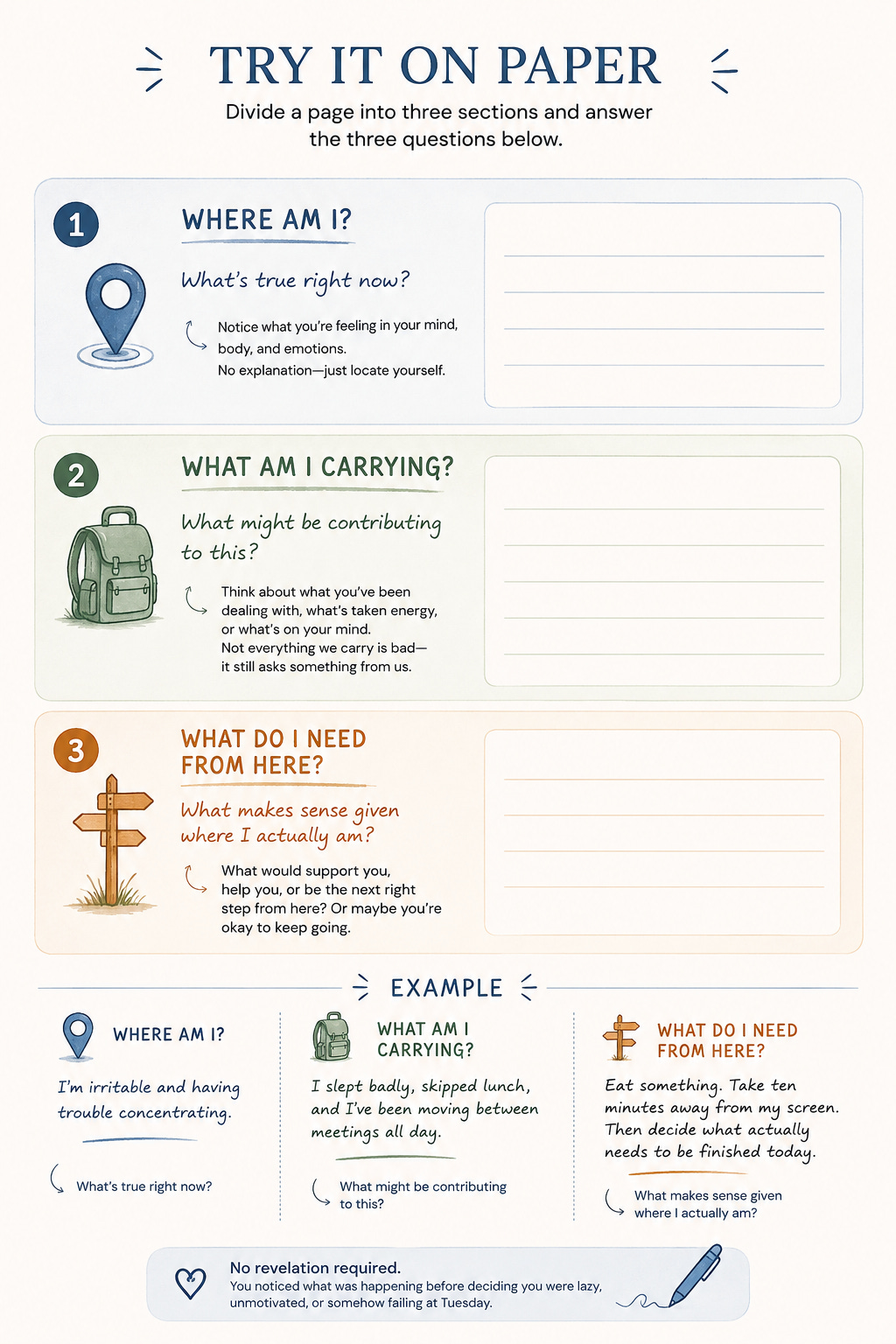
Try It On Paper
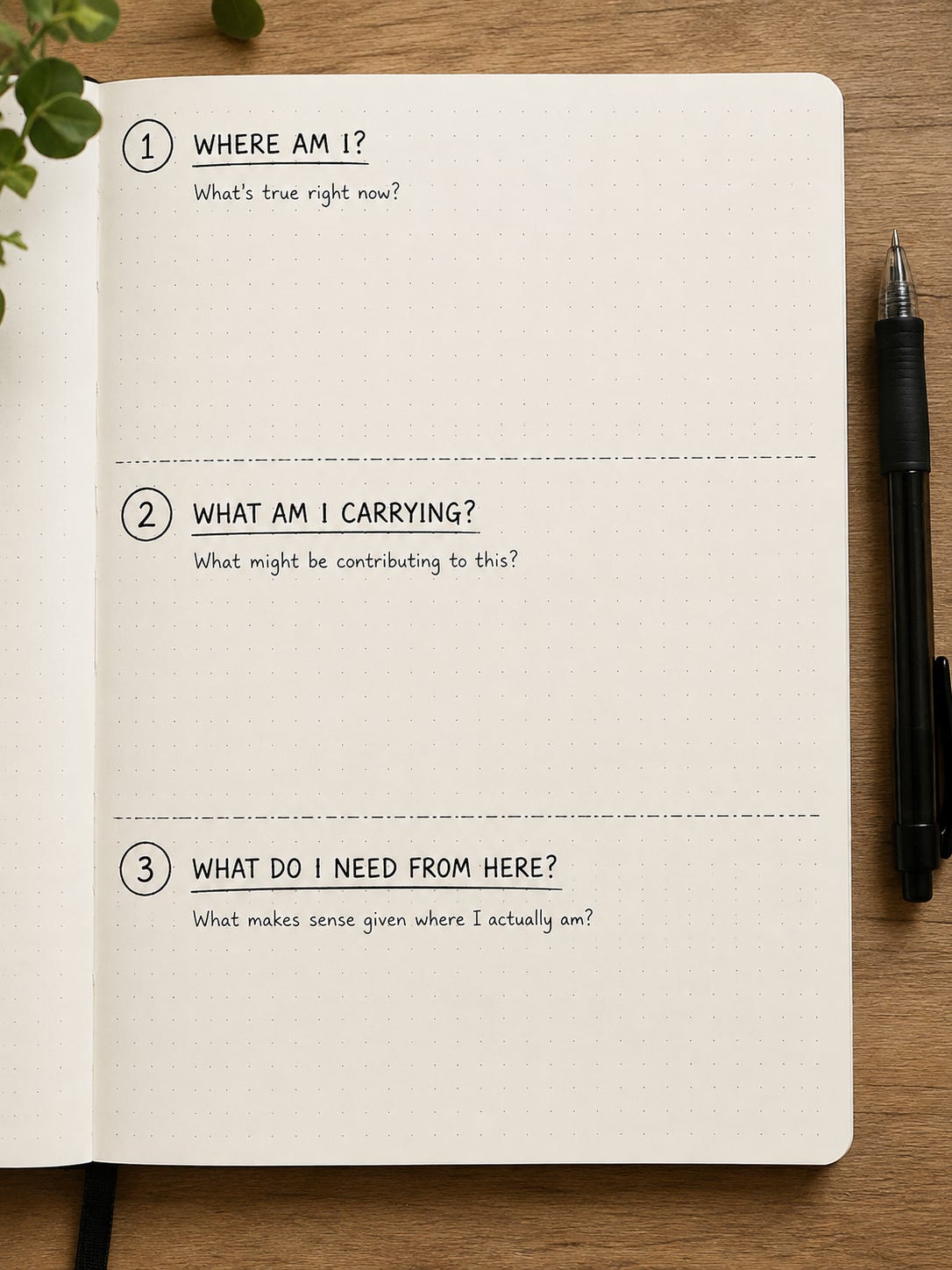
If you’re having trouble hearing yourself clearly, divide a page into three sections:
WHERE AM I?
What’s true right now?
WHAT AM I CARRYING?
What might be contributing to this?
WHAT DO I NEED FROM HERE?
What makes sense given where I actually am?
✍️For example:
WHERE AM I?
I’m irritable and having trouble concentrating.
WHAT AM I CARRYING?
I slept badly, skipped lunch, and I’ve been moving between meetings all day.
WHAT DO I NEED FROM HERE?
Eat something. Take ten minutes away from my screen. Then decide what actually needs to be finished today.
That’s it. No revelation required.
You noticed what was happening before deciding you were lazy, unmotivated, or somehow failing at Tuesday.
This Week’s Practice
Once a day for the next week, take two minutes and check in.
Ask yourself:
Where am I?
What am I carrying?
What do I need from here?
You can choose the same time each day, or use moments when you notice yourself moving into autopilot.
Especially try the self check-in before:
Automatically saying yes.
Pushing through exhaustion.
Reacting during a difficult moment.
Reaching for another distraction.
Turning how you feel into a conclusion about who you are.
You don’t need a perfect answer. You just need an honest one.
Signs It’s Working
You’ll know the practice is becoming useful when you start catching yourself earlier.
Before exhaustion becomes depletion.
Before irritation becomes an argument.
Before I’m struggling today becomes What’s wrong with me?
You notice sooner. So you can respond sooner.
The One-Line Reorientation
→ “Meet yourself before you manage yourself.”
When To Use This Skill
A Self Check-In can be especially useful when you feel off, but don’t know why.
When you’re about to make a decision from frustration.
When you keep pushing despite knowing something needs your attention.
When you’re telling yourself you should be handling things differently.
Or simply when it’s been a while since you asked yourself how you’re actually doing.
You don’t need to wait until something is wrong to check in.
Sometimes the answer is: I’m good.
Notice that too.
Why This Compounds Over Time
The value of checking in isn’t the two minutes themselves.
→ It’s what you begin noticing before those two minutes are necessary.
You recognize your limits earlier.
You get better at noticing what affects your energy.
You get better at recognizing what affects your capacity before automatically demanding more from it.
And you have better information when it’s time to decide what comes next.

Closing Reflection
You won’t always be able to change what you find.
→ Sometimes you’ll check in and realize you’re tired on a day that still requires something from you.
→ Sometimes you’ll need something you can’t have immediately.
The check-in isn’t valuable because it fixes what you find.
It gives you better information about what to do next.
So ask:
Where am I?
What am I carrying?
What do I need from here?
Meet yourself before you manage yourself.
Thank you for reading this article.
— Jessica
Your 2am friend who actually gets it
“Periodically, you’ll need to heal your motivations. It takes a significant amount of honesty with yourself to realize that greed and fear have crept too far into the center of your mind. Needing to reconnect yourself with your best intentions doesn’t mean you’re moving backwards; it just means you’re human.” —Yung Pueblo
Previous Weekly Skills


NP Fellow Collective Podcast & Playlists
MEDICAL DISCLAIMER
This content is for informational and educational purposes only. It is not intended to provide medical advice or to take the place of such advice or treatment from a personal physician. All readers/viewers of this content are advised to consult their doctors or qualified health professionals regarding specific health questions. All viewers of this content, especially those taking prescription or over-the-counter medications, should consult their physicians before beginning any nutrition, supplement or lifestyle program.
💙 A two-minute check-in for you:
Before you move on with your day, ask yourself:
Where am I?
What am I carrying?
What do I need from here?
You don’t have to fix whatever you find.
Sometimes noticing it is enough to change what you ask of yourself next.
If you’d like to share, what did your check-in help you notice today?
Thanks Jess!