

One grounded internal skill you can practice this week.

Why This Skill Matters
You make a mistake and almost immediately, your mind has something to say about it.
You should’ve known better.
That was stupid.
Why do you always do this?
Everyone else seems to have this figured out.
Sometimes the criticism is obvious.
Other times, it sounds almost responsible.
You really need to get it together.
You should be better at this by now.
There’s no excuse for that.
Because these thoughts happen in our own minds, we rarely stop to question who’s doing the talking.
We simply absorb them.
→ However a thought isn’t automatically true because you thought it and criticism isn’t automatically useful because it sounds like accountability.
This week’s skill is about learning to separate the useful information inside a difficult moment from the attack you add afterward because sometimes there’s something to learn, sometimes something needs to change, and sometimes you simply made a human mistake.
The skill is learning to know the difference.
What This Skill Is
Quieting your inner critic doesn’t mean eliminating negative thoughts.
It doesn’t mean replacing every difficult thought with a positive affirmation and it certainly doesn’t mean convincing yourself that everything you do is okay.
It’s much more practical than that.
→ You learn to notice what happened.
→ Then you notice what you’re saying about yourself because it happened.
Those aren’t always the same thing.
Maybe the truth is:
→ I wasn’t prepared.
The attack is:
I’m incompetent.
Maybe the truth is:
→ I regret what I said.
The attack is:
I ruin every relationship.
Maybe the truth is:
→ I made a mistake.
The attack is:
There’s something wrong with me.
The goal isn’t to make the truth prettier.
The goal is to stop adding cruelty to it.
Listen For The Tone, Too
Not every inner critic screams.
Sometimes it sounds perfectly reasonable.
You really should’ve known better.
Come on. You can do better than this.
There’s no reason you should still be struggling with this.
The words may not sound particularly vicious.
→ So pay attention to the tone.
Ask yourself:
Would I say this, in this tone, to someone I was genuinely trying to help?
→ If the answer is no, pay attention.
Criticism doesn’t stop being criticism just because it put on a blazer and called itself accountability.
The Practice: Catch → Find → Choose
The next time you notice yourself spiraling after a mistake, don’t try to silence the thought.
Do three things.
1. Catch The Attack
Start with exactly what you said to yourself.
Don’t clean it up and don’t make it sound reasonable.
Catch the actual sentence.
I’m such an idiot.
I always screw this up.
I can’t do anything right.
Everyone probably thinks I’m incompetent.
→ If you can, write it down.
Seeing the words in front of you can make it easier to recognize that you’re having a thought rather than simply accepting the thought as truth.
Then ask:
→ What am I saying about myself because of what happened?
That’s the attack.
2. Find The Truth
Now strip away the judgment and ask:
What actually happened?
Maybe:
I rushed and missed something important.
I wasn’t prepared enough.
I interrupted someone because I was defensive.
I forgot something I said I’d do.
I tried something and it didn’t work.
→ Stay with the facts.
Then ask:
Is there anything useful for me to learn here?
Maybe the answer is:
Next time I need to slow down.
I need to prepare differently.
I owe someone an apology.
I need to communicate sooner instead of waiting until I’m overwhelmed.
→ That’s useful information. Keep it.
You don’t have to keep the cruelty to learn from it.
3. Choose The Response
Once you know what’s actually true, ask:
What, if anything, needs to happen next?
Maybe you need to apologize.
Correct the mistake.
Ask for help.
Prepare differently.
Set a boundary.
Rest.
Try again.
Or maybe...nothing needs to happen.
That matters also because not every mistake contains a profound lesson.
Sometimes you drop the glass.
Forget someone’s name.
Miss the exit.
Say something awkward.
Have an unproductive day.
→ You’re allowed to be a human being without turning every imperfect moment into a character investigation.
If there’s something useful to learn, learn it.
If there’s something to repair, repair it.
If there’s nothing left to do?
Let yourself move on.
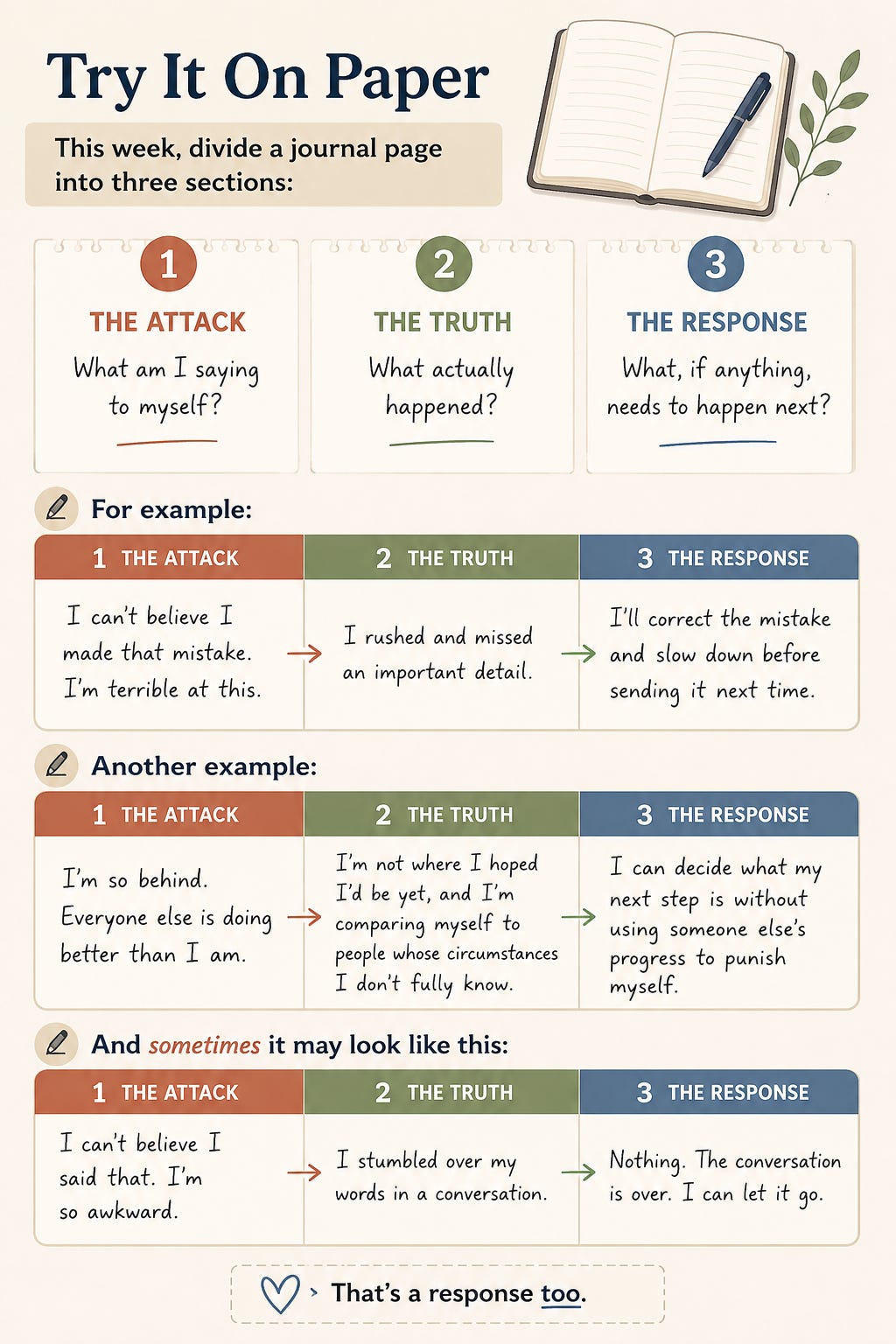
Try It On Paper
This week, divide a journal page into three sections:
THE ATTACK
What am I saying to myself?
THE TRUTH
What actually happened?
THE RESPONSE
What, if anything, needs to happen next?
✍️For example:
THE ATTACK
I can’t believe I made that mistake. I’m terrible at this.
THE TRUTH
I rushed and missed an important detail.
THE RESPONSE
I’ll correct the mistake and slow down before sending it next time.
✍️Another example:
THE ATTACK
I’m so behind. Everyone else is doing better than I am.
THE TRUTH
I’m not where I hoped I’d be yet, and I’m comparing myself to people whose circumstances I don’t fully know.
THE RESPONSE
I can decide what my next step is without using someone else’s progress to punish myself.
✍️And sometimes it may look like this:
THE ATTACK
I can’t believe I said that. I’m so awkward.
THE TRUTH
I stumbled over my words in a conversation.
THE RESPONSE
Nothing. The conversation is over. I can let it go.
That’s a response too.
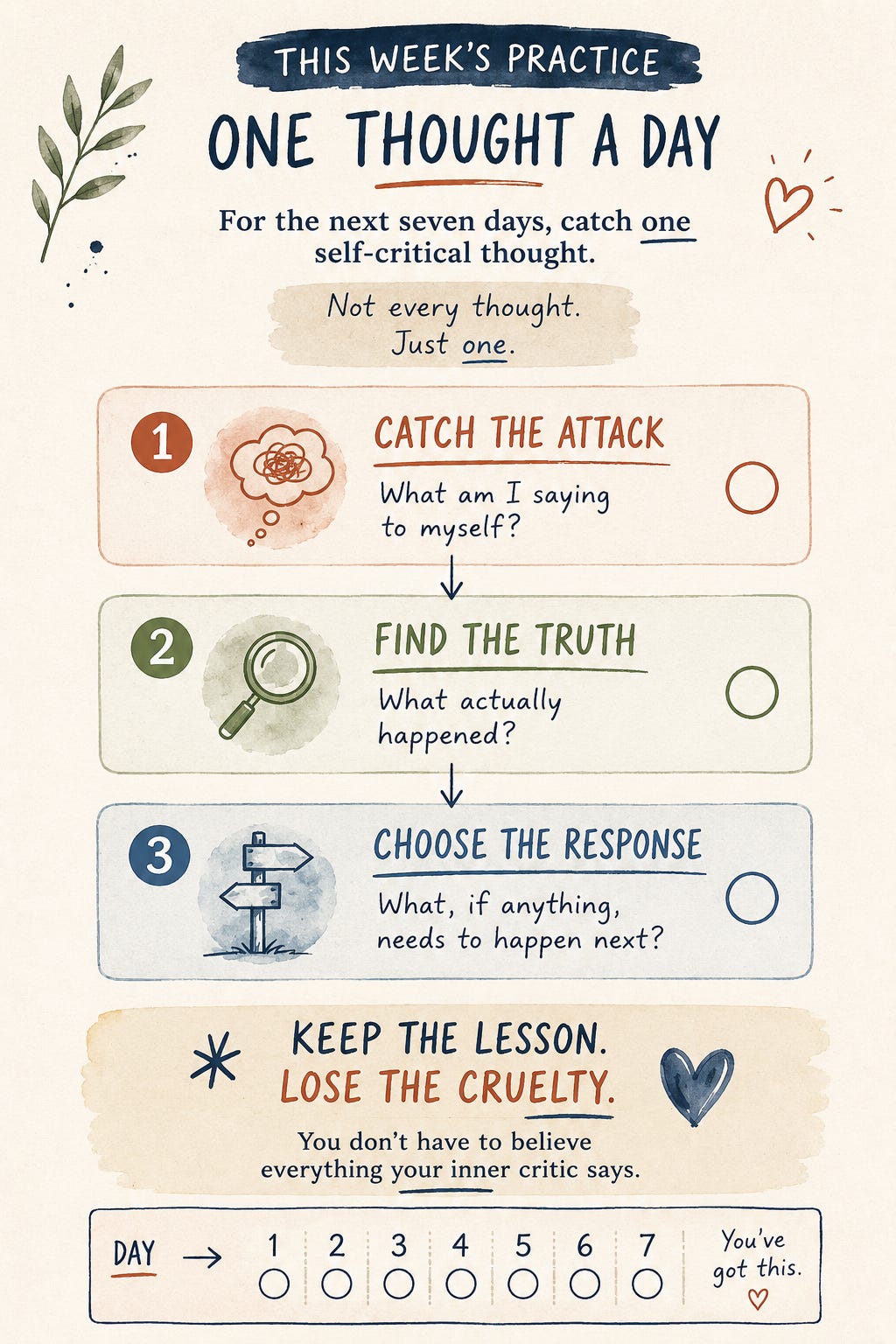
This Week’s Practice
For the next seven days, catch one self-critical thought each day.
Not every thought.
We’re not turning your brain into a surveillance operation.
Just one.
Then move through:
Catch the attack.
Find the truth.
Choose the response.
That’s enough.
The goal isn’t to become someone who never criticizes themselves again.
The goal to become someone who notices the criticism before automatically handing it authority.
Signs It’s Working
You may notice that you:
Catch harsh self-talk sooner.
Separate what happened from what you’re making it mean about you.
Recover from mistakes more quickly.
Take responsibility without spiraling into shame.
Recognize when something actually needs correcting.
Let smaller mistakes go without turning them into evidence against yourself.
Your inner critic may still show up.
Success isn’t never hearing it again.
Success is realizing you don’t have to believe everything your inner critic says.
The One-Line Reorientation
→ “Keep the lesson. Lose the cruelty.”
When To Use This Skill
Use this practice when:
You make a mistake and immediately start attacking yourself.
You notice yourself replaying something embarrassing.
You’re disappointed in your performance.
You’ve received criticism or difficult feedback.
You’re comparing yourself to someone else.
You know you need to take responsibility but shame is taking over.
A small mistake is starting to feel like evidence about who you are.
→ Especially notice the moments when your criticism feels deserved.
Those are often the moments when it’s hardest to separate accountability from punishment.
Why This Compounds Over Time
Every time you catch the attack and return to what is actually true, you practice a different relationship with yourself.
You still notice mistakes, you still have standards, and you still take responsibility, but you stop requiring humiliation as proof that you care.
Over time, the question begins to change.
Instead of:
What’s wrong with me?
You become more likely to ask:
What happened?
What can I learn?
What needs to happen next?
Those questions give you somewhere to go. Shame usually doesn’t.

Closing Reflection
Your inner critic may still show up.
That’s not failure.
→ The practice is noticing what it says before automatically treating it as truth.
Sometimes there will be something useful underneath the criticism.
Learn from it, repair what needs repairing, and change what needs changing.
And if there’s nothing left to learn?
→ Let yourself move on.
Keep the lesson. Lose the cruelty.
Thank you for reading this article.
— Jessica
Your 2am friend who actually gets it
“It’s easy to get lost in the infinite space of hypotheticals. Instead of focusing too much on what if, ground yourself in what is.” —Yung Pueblo
Previous Weekly Skills


NP Fellow Collective Podcast & Playlists
MEDICAL DISCLAIMER
This content is for informational and educational purposes only. It is not intended to provide medical advice or to take the place of such advice or treatment from a personal physician. All readers/viewers of this content are advised to consult their doctors or qualified health professionals regarding specific health questions. All viewers of this content, especially those taking prescription or over-the-counter medications, should consult their physicians before beginning any nutrition, supplement or lifestyle program.
Keep the lesson. Lose the cruelty.
Your inner critic may contain useful information, but you don't need the shame attached to it.
This week, I'm curious:
What's one thing your inner critic says that you could respond to with more accuracy and self-compassion?
One thing lose in life and you don’t even have a choice to make anymore but get it together you