


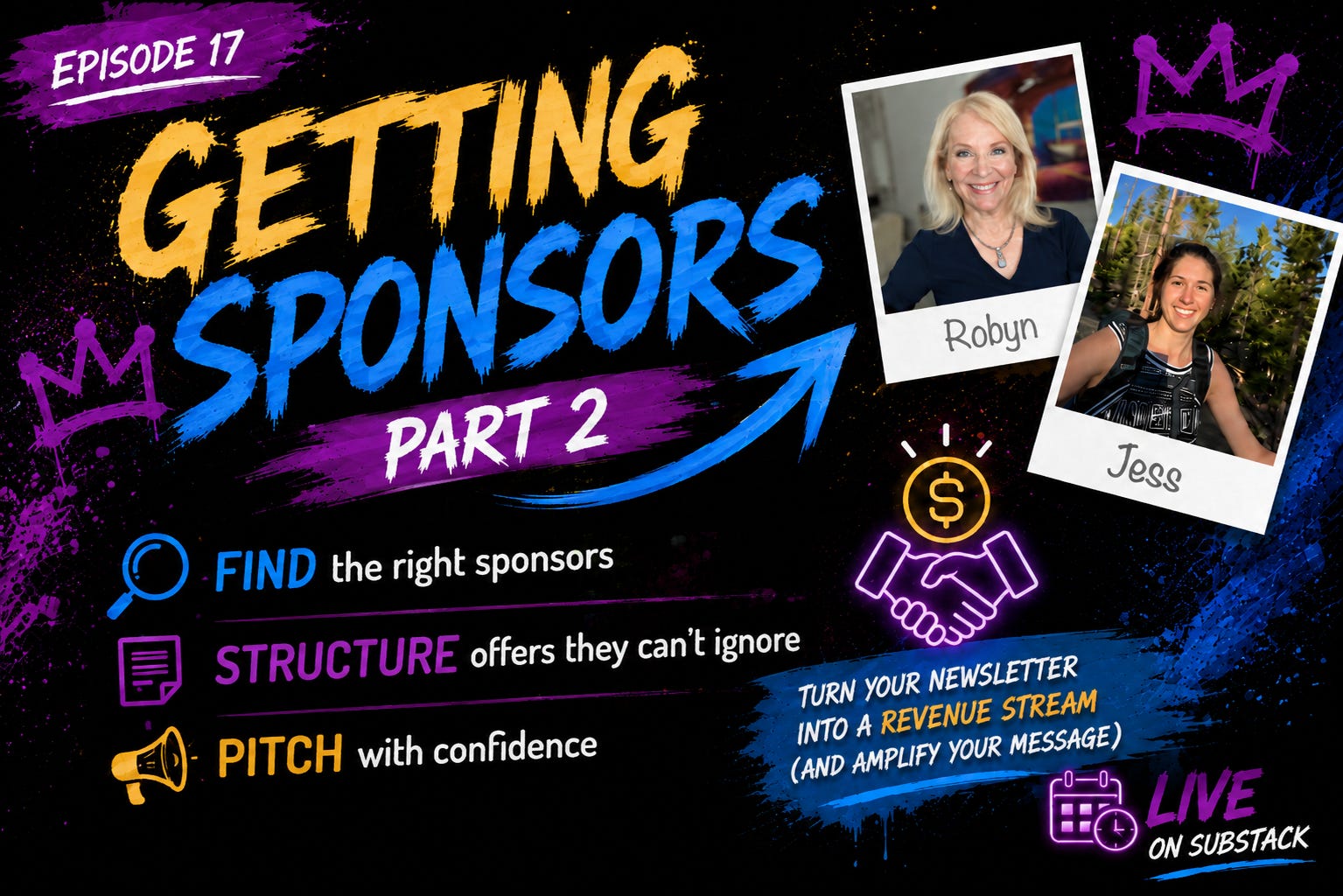
Editor’s Note: This article is based on Episode 017 of Unstuck to Finding Your Edge, my weekly Substack Live series with Robyn Levin of Finding Your Edge. Last week, Robyn challenged me to build a dream list of companies I’d love to work with. I did the homework. This week, I learned why making the list was the easy part.
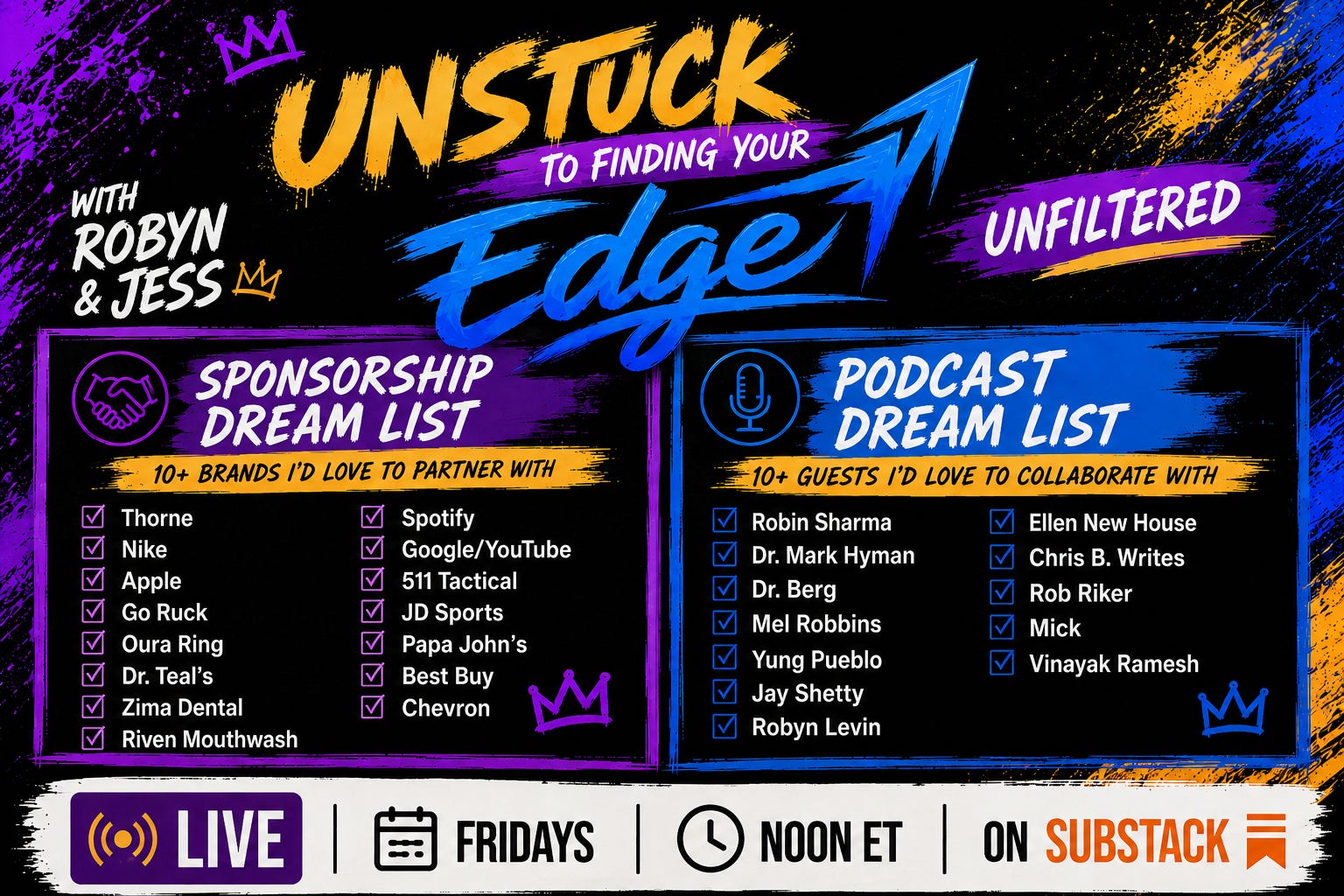
Last week, Robyn gave me homework.
→ Build a list of companies I’d genuinely want to work with.
So I did.
Thorne.
Nike.
Apple.
Oura.
GORUCK.
Dr Teal’s.
Spotify.
A few smaller health and wellness brands and several others.
I also built a second list of people I’d love to interview on my podcast—or whose podcasts I’d love to appear on.
I had the names, I had the ideas, and I was ready for the next step.
Then Robyn told me:
“Don’t pitch anyone yet.”
Well, damn. 😂
Because apparently having a dream sponsor list and being ready to approach those sponsors are two very different things.
→ Before I email anyone, I need to know why they should care about NP Fellow Become the CEO of Your Health.
What I could actually offer them.
Why their company makes sense for my audience.
What proof I have that the partnership could work.
Who the hell I’m supposed to email in the first place.
That’s what Episode 017 became about.
→ Not how to land a sponsor, but what to do before you ever ask for one.
And the process is much simpler when you break it down.
1. Find The Fit
When you have a dream company in mind, it’s tempting to jump straight to:
How much should I charge them?
Wrong question.
Robyn had me start with two others:
Why me?
Why them?
→ Why does your publication make sense for this company and why does this company make sense for your audience?
That’s where the partnership starts.
Nike was one of the biggest companies on my dream list.
My original reasoning?
I love Nike, I wear Nike shoes, I work out in Nike clothes, and I’ve worn the brand for as long as I can remember.
Cool. So have millions of other people.
That’s not a partnership story.
Then Robyn kept asking:
Why Nike?
And the deeper we went, the more connections appeared.
I’ve been wearing Nike since elementary school.
I grew up playing competitive hockey and have spent most of my life as an athlete.
Sports, movement, discipline, health, and mindset naturally overlap with what I write about at NP Fellow.
Nike is all over my family’s closets.
I even have Nike artwork in my office.
And then another piece surfaced during the Live.
→ My dad used to design shoes. 🐐
He’s part of the reason my family became interested in them in the first place.
Suddenly, I like Nike wasn’t the story anymore.
There was history.
Athletics.
Family.
Health.
Mindset.
A real relationship with the brand.
You don’t need a childhood story about every company you approach, but you should be able to answer:
→ Why did this company make my list in the first place?
If the only answer is because they have money, keep looking.
2. Define What You Can Actually Offer
Once you know why the partnership makes sense, ask:
→ What could we actually create together?
This is where I had been thinking too narrowly.
Sponsorship doesn’t have to mean sticking a traditional ad in the middle of a newsletter.
For NP Fellow, Robyn and I talked about possibilities like:
Sponsoring an individual Sunday article
Sponsoring my Weekly Skill series
A podcast sponsorship
A host-read podcast message
A longer-term partnership
Products or gift cards for readers
Sponsoring a reader challenge
That last one got my attention.
Imagine a health or fitness company contributing products to a challenge for NP Fellow readers.
→ The readers get something useful.
→ The company reaches people who are relevant to what they sell.
→NP Fellow gets to create an experience for the community.
Now we’re not talking about selling a rectangle in an email.
We’re talking about creating something together.
So before you ask:
How much can I charge?
Ask:
What could I create that would be valuable to this company AND my audience?
Price comes later.
3. Bring Proof
You know your audience is valuable.
The company you’re approaching doesn’t know that yet.
→ Give them a reason to believe you.
Robyn’s next homework assignment for me was to go through my publications and find evidence.
Strong-performing articles.
Views.
Engagement.
Comments.
Shares.
Downloads.
Subscriber growth.
Audience response.
And, when possible, content that’s directly connected to the company I’m approaching.
I’ve written about Nike before in my stock-market publication.
If those pieces performed well, that’s useful.
Now I’m not saying:
I think my readers would care about Nike.
I can show evidence that they already have.
I did push back on relying too heavily on email open rates because Substack readers don’t only consume publications through email. They may read through the app or elsewhere on the platform.
That led to an important point:
→ One metric doesn’t tell the entire story.
You don’t need to dump a spreadsheet of analytics on a potential sponsor.
You need enough evidence to show that the opportunity you’re describing isn’t something you invented five minutes before sending the email.
4. Find A Person, Not An Inbox
This is the part I wouldn’t have known how to navigate on my own.
You have the company.
You understand the fit.
You have an idea.
You have proof.
Now...
→ Who do you contact?
Robyn’s advice was simple:
“Avoid blindly throwing your pitch into a generic company inbox if you can.”
Investigate first.
Look at the company’s website.
Search for departments or programs related to:
Partnerships.
Collaborations.
Creators.
Affiliates.
Influencers.
Marketing.
Check LinkedIn.
Look through the company’s social accounts.
→ Try to identify the department, or better yet, the person who handles the kind of partnership you’re proposing.
And Robyn gave me another route I hadn’t considered.
→ An affiliate department can be an entry point even if you don’t want to become an affiliate.
You could contact them and say:
“I see you have an affiliate program. I have a different partnership idea for my publication. Who would be the best person to speak with?”
→ You’re not pitching yet. You’re finding the door.
As I said during the Live:
“It’s getting your foot in the door.”
5. Remember: The First Email Isn’t The Pitch
This may have been the biggest shift for me.
I thought the first email was the pitch.
Robyn reframed the entire thing.
→ The first email isn’t the pitch. It’s the introduction.
That changes everything.
You don’t need to cram your life story, media kit, pricing, audience demographics, six sponsorship packages, and a desperate PLEASE RESPOND into one email.
→ You’re opening a conversation.
Your first contact needs to answer a few basic questions:
Who are you?
Why them?
Why you?
What opportunity do you see?
That’s enough to start.
Maybe the next step is another email.
Maybe it’s a phone call.
Maybe it’s a meeting.
Maybe they ask for your media kit or a proposal.
The immediate goal isn’t necessarily to close the sponsorship.
→ The goal is to get the right person interested enough to continue the conversation.
That made pitching feel a hell of a lot less intimidating.
6. Make The Opportunity Obvious
A company shouldn’t have to reverse-engineer your email to understand why you’re contacting them.
Make the connection easy to see.
At its simplest:
Here’s my audience.
Here’s why your company fits.
Here’s what we could create.
Here’s why it could benefit you.
That’s it.
You’re not asking a company to invent the partnership for you.
You’re showing them an opportunity they may not have considered.
7. Build A Sponsorship Pipeline
Once you start researching and contacting multiple companies, your brain is no longer an acceptable CRM. 😂
→ Track the process.
At minimum, keep:

You want to know:
Who did I contact?
When?
Did they respond?
Who is the correct person?
When should I follow up?
What did we discuss?
What happens next?
Because a dream list is just a list.
It becomes a strategy when you start putting names, dates, actions, and outcomes beside it.
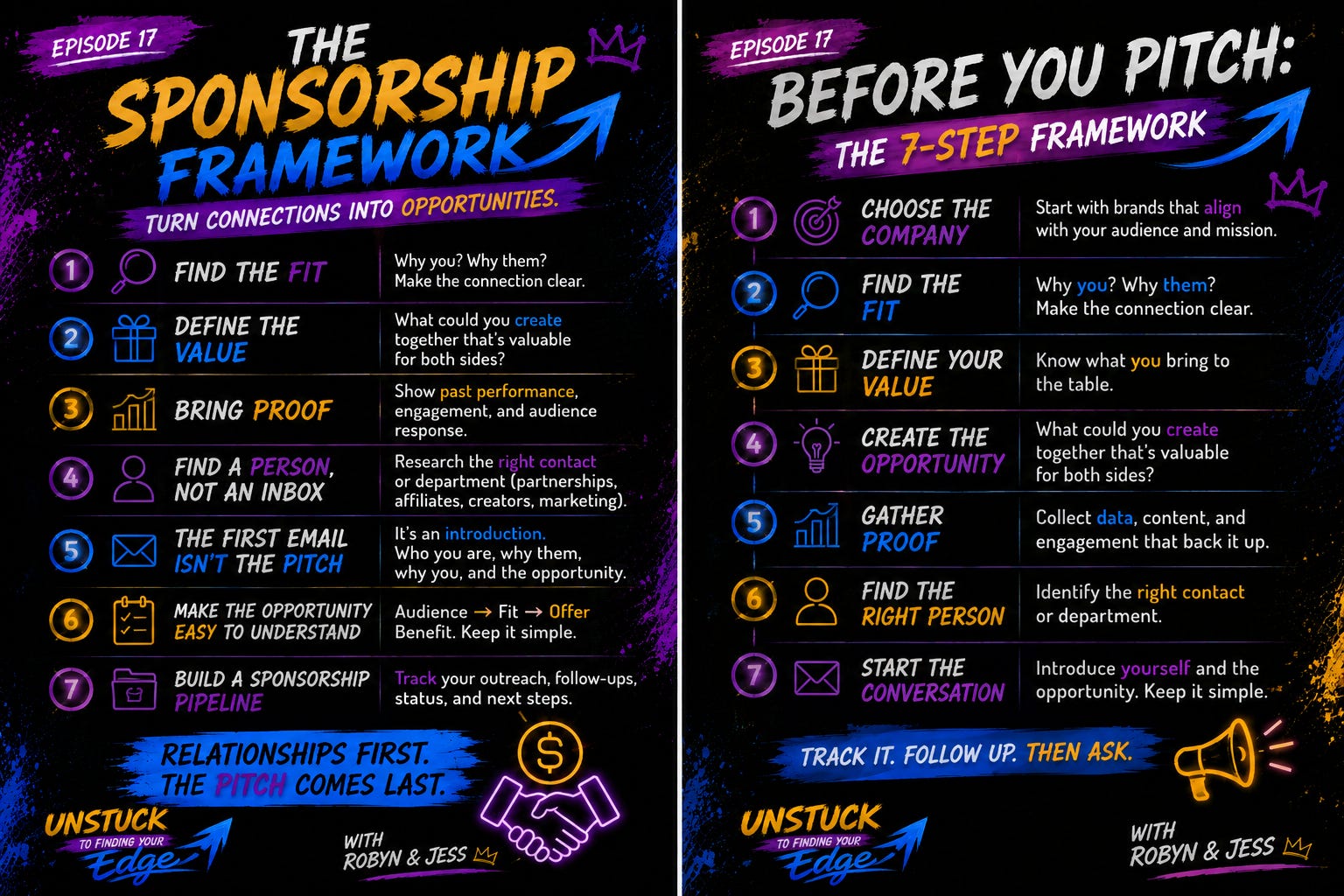
The Before-You-Pitch Framework
So here’s the process I’m following now:
1. Choose the company.
Start with brands that genuinely overlap with your publication and audience.
2. Find the fit.
Answer: Why me? Why them?
3. Define your value.
Know what you bring beyond your subscriber count.
4. Create the opportunity.
Decide what you and the company could actually do together.
5. Gather proof.
Find the content, engagement, audience response, and data that support your idea.
6. Find the person.
Look for the person or department responsible for partnerships, creators, affiliates, collaborations, or marketing.
7. Start the conversation.
Introduce yourself and the opportunity without trying to close the entire deal in one email.
Then?
Track it, follow up, and eventually...Ask.
You Can’t Get What You Don’t Ask For
During the Live, Robyn told me about some of the unconventional sponsorships she’s landed over the years.
Coca-Cola.
Bauer.
Rollerblade.
Subway.
Even a Jaguar dealership for an event.
→ She saw connections between companies and the audiences she already had.
→ Then she asked whether those companies wanted to participate. (that’s it)
At one point I said: “You really don’t know what you don’t ask for.”
Robyn corrected me: “You really can’t get what you don’t ask for.”
And THAT may be the lesson I carry with me from these sponsorship conversations.
Episode 016 helped me realize that NP Fellow may be more sponsorable than I thought.
Episode 017 taught me that getting a sponsor doesn’t begin with firing off a giant proposal to Nike.
It starts much smaller.
Know your audience and know your value.
Find the connection.
Create the opportunity.
Gather the proof.
Find the person.
Start the conversation.
Then ask.
Final Thoughts
I started this process thinking sponsorship meant finding a company, deciding what to charge, and sending a pitch.
Now I see the pitch is almost the last step.
First, you have to know why the partnership makes sense.
What you bring.
What you could create together.
Why your audience would care.
Who you’re actually talking to.
I still haven’t pitched Nike, but I’m a hell of a lot closer than I was last week. 🥳😱
Next, comes the part I’ve been preparing for: The ask.
Want to Go Deeper on Sponsorships?
There’s also something worth celebrating.
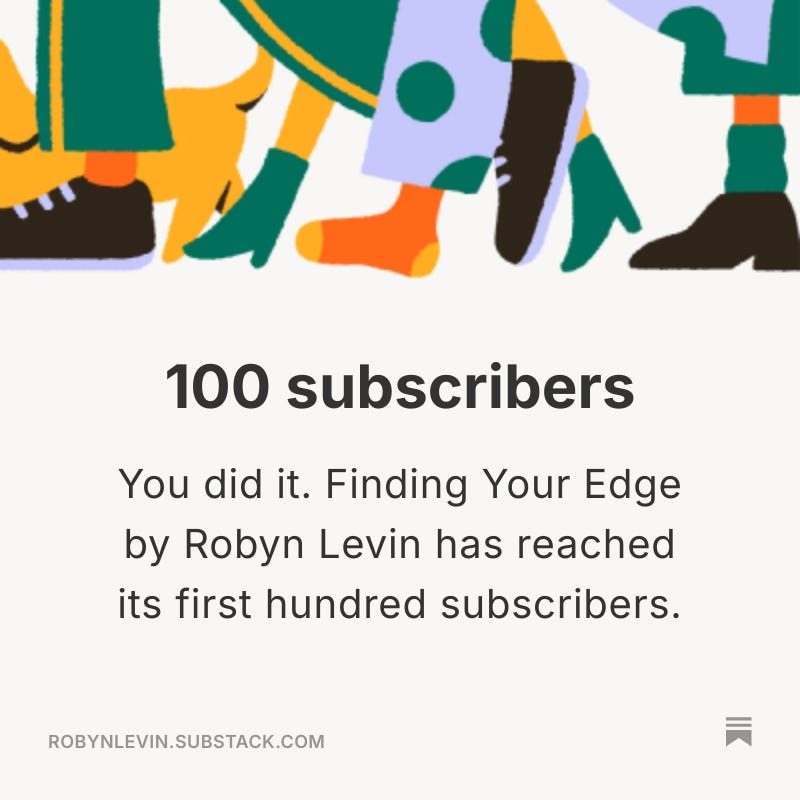
Robyn’s Finding Your Edge just reached its first 100 subscribers!!
To celebrate, she’s offering a limited-time, one-time upgrade opportunity for her publication.
She’s also introducing her Sponsorship Playbook & Workbook, Your Sponsor Kit Edge™, which draws on decades of her real-world sponsorship experience. 🐐
If these sponsorship conversations have you thinking, “I want to try this with my own publication”, Robyn’s new resource gives you a place to keep going.
→ Click below to learn more and celebrate 100 subscribers with Robyn at Finding Your Edge.
Watch Episode 017
Want to see us work through this in real time?
In Episode 017 of Unstuck to Finding Your Edge, Robyn Levin and I go through my actual dream sponsor list and work through fit, offers, proof, contacts, and what my first outreach should look like.
And yes...my campaign to manifest Nike as an NP Fellow sponsor continues. 😂
↑ Watch Episode 017 of Unstuck to Finding Your Edge above.
Resources From This Conversation
Follow Jess at NP Fellow Become The CEO of Your Health →

Follow Jess at Nurse in the Market →


Follow Jess at Unstuck to Published →

Follow Robyn at Finding Your Edge →

Follow Robyn at Rare Finds - Luxury Travel →

Scan Robyn’s QR code to access her Youtube channel →
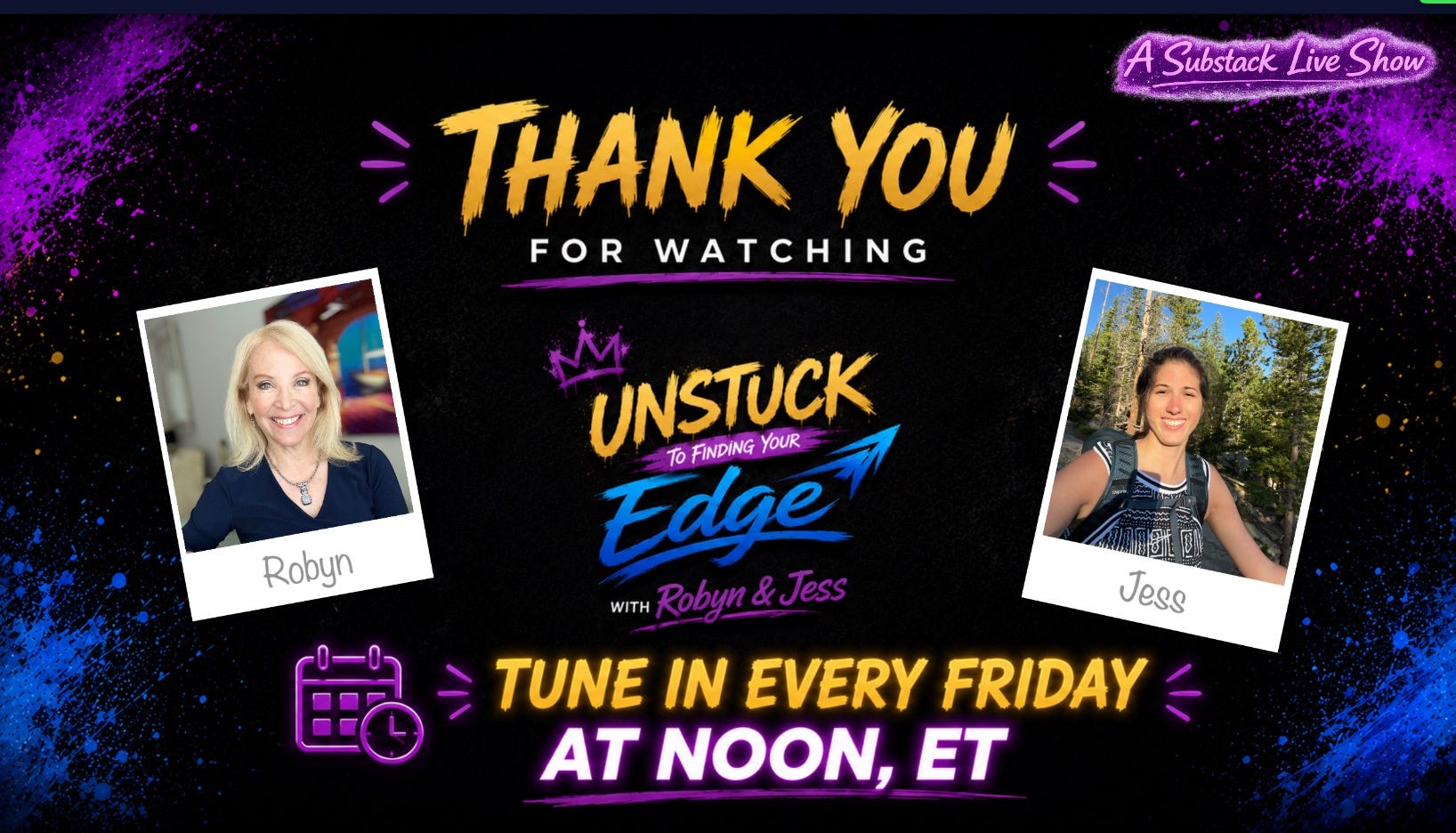
Thank You
Thank you so much for everyone who tuned into this live, your presence is truly appreciated, and to the people who are watching the replay, thank you!
See you next Friday at 12pm ET for our weekly show, stay tuned!
-Jess, The Creator & Robyn Levin


