

One grounded internal skill you can practice this week.

Why This Skill Matters
Listen to what happens when someone asks us to talk about ourselves.
“I just helped with the project.”
“I kind of came up with the idea.”
“I was lucky enough to get the opportunity.”
“I guess I’m pretty good at it.”
“I don’t know if I’m qualified, but…”
We add tiny escape hatches to the sentence.
Just.
Kind of.
Maybe.
I guess.
Lucky.
Sometimes we think this makes us sound humble, but those words can also make what we’re saying less accurate.
This week’s skill is about noticing when you shrink your own contribution, strength, or desire and practicing something different:
Make the clear claim.
Say what’s true. Then leave it alone.
What This Skill Is
A clear claim is a direct, accurate statement about something you did, something you do well or something you want.
For example:
I led the project.
I’m good at explaining complicated ideas clearly.
I’m proud of what I created.
I’d like to be considered for the position.
Notice what isn’t there.
No apology, no unnecessary qualifier, and no attempt to convince anyone you’re extraordinary.
→ You’re simply giving accurate information.
That’s the skill.
The Common Mistake
When people hear self-promotion, they often imagine they need to become more impressive.
Talk themselves up, sound confident, and sell themselves, but if that feels unnatural, we tend to run in the opposite direction.
We minimize.
The goal isn’t to replace:
“I just helped.”
with:
“This entire project would have collapsed without my brilliance.”
Please don’t.
The goal is to make the sentence accurate.
No inflation and no minimization.
If you contributed, say how.
If you led, say you led.
If you’re good at something, name it.
If you want something, ask to be considered.
The Practice: Catch → Check → Claim
1. Catch The Shrink
Start by listening for the words you use when talking about yourself.
Especially:
just
kind of
maybe
I guess
I got lucky
it wasn’t a big deal
anyone could have done it
I don’t want to brag, but…
You may also notice yourself giving away the subject of the sentence.
Instead of: “I created the proposal.”
you say: “We had this proposal…”
Even though you created it.
You don’t have to police every word you say.
Just start noticing when your language makes your actual contribution smaller.
2. Check The Facts
Before trying to sound more confident, ask something simpler:
What actually happened?
Not the humble version and not the impressive version.
The accurate one.
Did you help with the project? Or did you lead it?
Did you get lucky? Or did an opportunity appear that you were prepared to take?
Did you kind of create something? Or did you create it?
Did everyone contribute? Great. What did you contribute?
This step matters because self-promotion without accuracy becomes exaggeration.
We’re not doing that.
We’re looking for the sentence you can stand behind without making it bigger or smaller than it is.
3. Make The Clear Claim
Now say the accurate version.
Instead of:
“I just helped organize the project.”
Try:
→ “I organized the project.”
Instead of:
“I guess I’m pretty good at bringing people together.”
Try:
→ “One of my strengths is bringing people together.”
Instead of:
“I was lucky enough to get promoted.”
Try:
→ “I earned a promotion.”
Instead of:
“I don’t know if I’m qualified, but I thought maybe I could be considered.”
Try:
→ “I’d like to be considered.”
Then comes the surprisingly difficult part.
Stop talking.
Don’t rush in to soften the sentence.
Don’t explain why it wasn’t actually that impressive.
Don’t immediately list everyone who helped because you suddenly feel guilty for using the word.
Let the accurate statement stand.
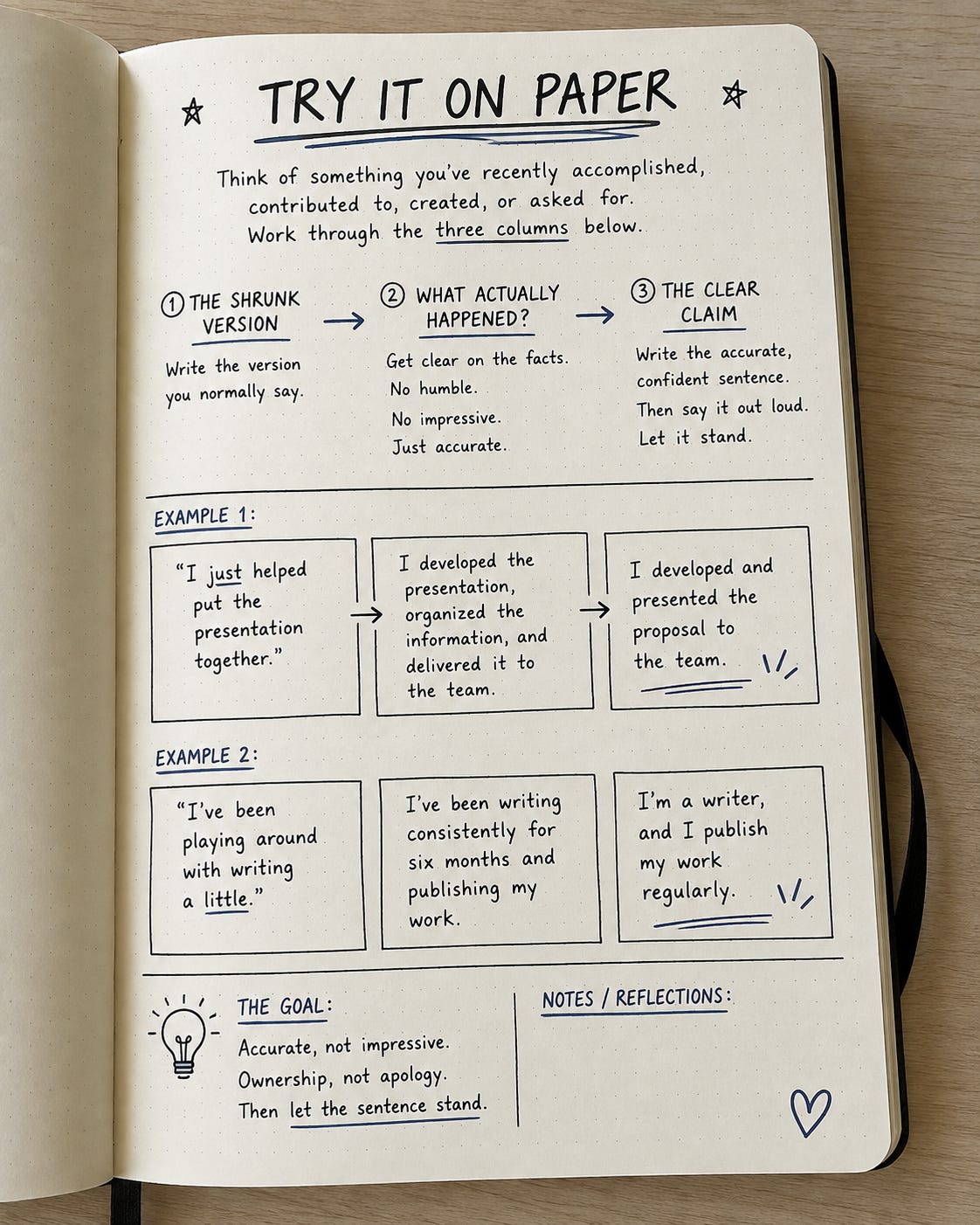
Try It On Paper
Think of something you’ve recently accomplished, contributed to, created, or asked for.
Write the version you normally say first.
1. THE SHRUNK VERSION
“I just helped put the presentation together.”
Now ask:
2. WHAT ACTUALLY HAPPENED?
I developed the presentation, organized the information, and delivered it to the team.
Then write:
3. THE CLEAR CLAIM
“I developed and presented the proposal to the team.”
A second example:
1. THE SHRUNK VERSION
“I’ve been playing around with writing a little.”
2. WHAT ACTUALLY HAPPENED?
I’ve been writing consistently for six months and publishing my work.
3. THE CLEAR CLAIM
“I’m a writer, and I publish my work regularly.”
→ Read your clear claim out loud.
If it makes you slightly uncomfortable?
Good. Don’t immediately rewrite it into something smaller.
Self-Promotion Isn’t Only About Work
You don’t need a promotion, resume, business, or LinkedIn account to practice this.
Maybe you made something you’re proud of.
“I painted this.”
Maybe you finished something difficult.
“I’m proud that I finished it.”
Maybe you have an idea you want people to hear.
“I have an idea I’d like to share.”
Maybe someone compliments you.
Instead of explaining why the compliment isn’t entirely deserved: “Thank you. I’m proud of it too.”
Maybe there’s something you want.
“I’d like the opportunity to try.”
The circumstances change. The skill doesn’t.
Can you tell the truth about yourself without immediately taking some of it back?
This Week’s Practice
For the next seven days, make one clear claim each day.
Nothing dramatic.
Catch one moment when you’re about to minimize something you did, want, or do well.
Then:
Catch the shrink.
Check the facts.
Make the clear claim.
Maybe it happens in a meeting.
An email.
A conversation with a friend.
An application.
A social post.
Or simply when someone asks what you’ve been working on.
One sentence. No performance required.
Signs It’s Working
You may notice yourself catching the just, kind of, or maybe before it leaves your mouth.
You accept a compliment without explaining it away.
You say what you contributed without immediately handing the credit somewhere else.
You ask for an opportunity instead of hoping someone thinks of you.
You’ll know the skill is working when the accurate sentence starts feeling less uncomfortable to say.
The One-Line Reorientation
→ “Say the true thing. Then stop shrinking it.”

Closing Reflection
For many of us, the hardest part isn’t knowing what we’ve done.
It’s saying it plainly.
So this week, listen for the moment when you start making the sentence smaller.
Pause and ask:
What actually happened?
Then say that and resist the urge to explain it away.
Let the sentence stand.
Thank you for reading this article.
— Jessica
Your 2am friend who actually gets it
“It was not time that healed you; it was your courage to feel everything you used to run from.” —Yung Pueblo
Previous Weekly Skills


NP Fellow Collective Podcast & Playlists
MEDICAL DISCLAIMER
This content is for informational and educational purposes only. It is not intended to provide medical advice or to take the place of such advice or treatment from a personal physician. All readers/viewers of this content are advised to consult their doctors or qualified health professionals regarding specific health questions. All viewers of this content, especially those taking prescription or over-the-counter medications, should consult their physicians before beginning any nutrition, supplement or lifestyle program.
💙 Your turn: Make the clear claim.
What’s one thing you’ve done, created, contributed to, or become good at that you usually make smaller when you talk about it?
Catch the just. Lose the kind of. Skip the disclaimer.
Say the accurate version.
I’ll start you off:
“I’m proud that I published multiple posts and guest-hosted a podcast.”
Now fill in the blank.
And then?
Let the sentence stand.
This is something I needed to read. Making a clear claim is something I’ve struggled with for a long time. Writing it down is actually really helpful! Thank you 💛