

One grounded internal skill you can practice this week.
Why This Skill Matters
Some places make you breathe a little deeper before you even realize it.
Some people make your shoulders drop the moment they walk into the room.
Some dogs deserve honorary therapy licenses.
None of that’s an accident.
→ Your body has been quietly keeping track of the moments that feel safe for years.
This week’s skill is about noticing those patterns, so you can return to them more intentionally.
What This Skill Is
A Safety Map is a collection of the people, places, animals, experiences, and sensory cues that help your body settle.
This isn’t a list of your favorite things.
→ It’s a map of the moments that help you feel more grounded.
Sometimes those are the same thing and sometimes they aren’t.
No two Safety Maps will look alike.
That’s exactly what makes them useful.
The Common Mistake
Most of us don’t think about regulation until we’re already overwhelmed.
We’re anxious, emotionally flooded, or already running on empty.
Then we ask,
“How do I calm down?”
→ The problem is we’re trying to solve it in the middle of the storm.
It’s like looking for a fire extinguisher after the kitchen’s already caught fire.
It’s much easier when you already know what helps.
Why This Works
Your brain and body are constantly scanning for one thing:
“Am I safe?:
The answer doesn’t come from thinking harder.
→ It comes from experience.
Every time you feel calmer around a certain person, in a familiar place, or during a particular activity, your brain remembers it.
The more often you return to those experiences, the easier they become to reach for when life feels overwhelming.
You’re not teaching your body something new.
You’re reminding it of something it already knows.
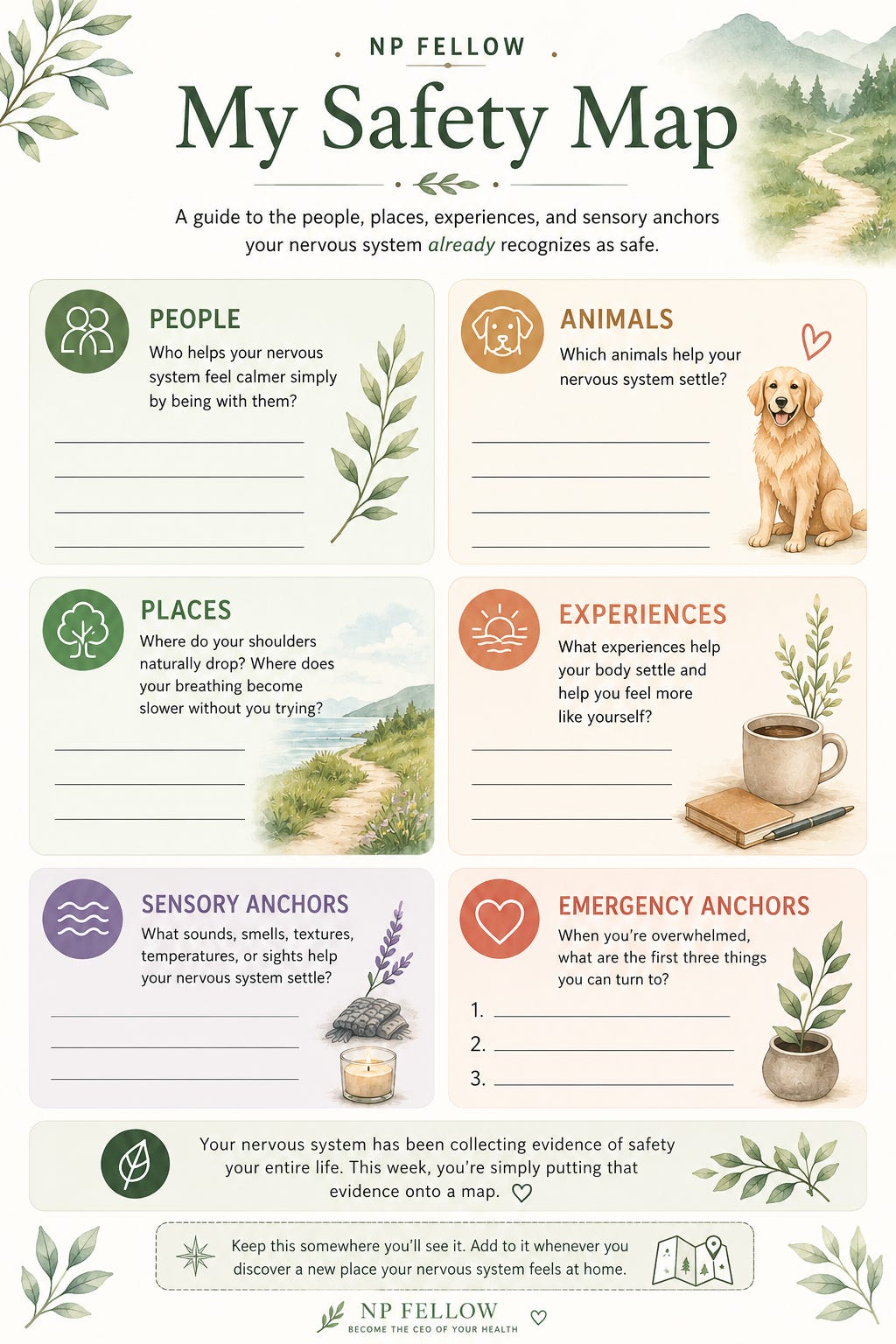
Draw Your Safety Map
Instead of asking:
“How do I calm down?”
Try asking:
→ “When do I naturally feel a little more settled?”
Then start paying attention.
👤 People
Who helps you exhale simply by being themselves?
Not the person who always has the perfect advice.
The person whose presence makes everything feel just a little less heavy.
→ Write their names down.
🐶 Animals
Animals have an incredible way of helping us regulate.
Maybe it’s your dog greeting you at the door.
Your cat curled up beside you.
A horse you ride.
Watching birds outside your window.
→ Notice what changes when they’re nearby.
🌿 Places
Where do you feel yourself unclench?
Maybe it’s:
Your backyard
Your favorite walking trail
The beach
Your favorite chair
A quiet coffee shop
Drinking your favorite coffee
The park or nature trail near your home
The places that help us most usually aren’t extraordinary.
They’re familiar and sometimes that’s exactly what we need.
🌅 Experiences
What helps you feel more like yourself?
Walking or hiking.
Gardening or attending to your plants.
Cooking.
Reading.
Prayer.
Writing.
Swimming.
Listening to music.
Watching the sunrise or sunset.
These moments do more than fill your time.
They give your body space to soften.
✨ Sensory Anchors
Sometimes safety arrives through the senses before we can explain why.
Think about:
Warm tea or coffee
Ocean waves
A dog snoring
Birds singing
Rain on the roof
Lavender
Soft lighting
Your favorite blanket
The feeling of your dog’s fur beneath your hand
Don’t underestimate the small things. They often leave the biggest impression.
🚨 Your Three Emergency Anchors
When life feels overwhelming, what are the first three things you can do that reliably help you begin settling?
Keep them simple and keep them realistic.
For example:
Take my dog for a 10-minute walk.
Sit outside with my morning coffee.
Listen ocean waves.
Watch the sunrise or sunset.
Call someone who helps me feel grounded.
Go for a nature walk.
Pet the dogs for ten minutes.
Your list will be different. That’s the point.
Your Weekly Practice
Ask yourself:
What just happened?
Who was I with?
Where was I?
What changed?
→ Write it down.
You aren’t chasing calm.
You’re learning to recognize where it already exists and don’t overlook the ordinary moments. They’re often doing more for you than you realize.
How You Know It’s Working
You may notice:
You recognize stress earlier.
You reach for healthy coping strategies sooner.
You recover more quickly after difficult moments.
You become more intentional about the environments you spend time in.
You trust your body’s signals a little more.
Most importantly...you stop hoping calm will show up by accident.
You start creating more opportunities to experience it.
The One-Line Reorientation
→ “Your body has been collecting evidence of safety your entire life.”
This week, you’re simply drawing the map.
Closing Reflection
Healing doesn’t always begin by learning something new.
Sometimes it begins by noticing what’s been quietly helping you all along.
The people.
The places.
The routines.
The little moments that help you breathe a little easier.
They’ve probably been there longer than you realized.
This week, draw your Safety Map.
You might discover you’ve had more sources of support than you ever gave yourself credit for.
I’d love to hear from you. 🫶
What’s one person, place, animal, or experience that’s on your Safety Map?
Share it in the comments.
Your answer might help someone else discover a place where they can finally exhale.
Thank you for reading this article.
— Jessica
Your 2am friend who actually gets it
“Instead of saying “I'm sad,” reframe it to “ sadness has temporarily appeared” or “sadness is passing through me.” —Yung Pueblo
Previous Weekly Skills


NP Fellow Collective Podcast & Playlists
MEDICAL DISCLAIMER
This content is for informational and educational purposes only. It is not intended to provide medical advice or to take the place of such advice or treatment from a personal physician. All readers/viewers of this content are advised to consult their doctors or qualified health professionals regarding specific health questions. All viewers of this content, especially those taking prescription or over-the-counter medications, should consult their physicians before beginning any nutrition, supplement or lifestyle program.
One sentence I kept coming back to while writing this:
"Your nervous system has been collecting evidence of safety your entire life. This week, you're simply putting that evidence onto a map."
I hope this becomes a resource you return to whenever you need it.
When you feel settled, you just feel better.