

One grounded internal skill you can practice this week.

Last Sunday, we talked about what can happen when you get really good at reading the room.
You notice what everyone else wants.
What will keep the peace.
What you’re supposed to do.
What might disappoint someone.
And sometimes your own voice gets lost in all that information.
So this week, we’re practicing a way to bring it back into the conversation because “stay true to yourself” sounds nice, but it’s pretty useless advice if you haven’t figured out what you actually want to stay true to.
That’s where values come in.
Why This Skill Matters
When the answer to a decision isn’t obvious, we tend to reach for whatever information is easiest to access.
What will other people think?
What am I supposed to do?
What would be easiest?
What will cause the least conflict?
Those questions aren’t necessarily bad.
However, there’s another one worth asking:
What matters to me?
→ Knowing your values gives you something to check your choices against.
They don’t need to run the decision. They need a vote.
What This Skill Is
The skill is simple:
→ Choose your values, define what they look like in behavior, and consult them when you make decisions.
Values are the qualities and priorities you want reflected in the way you live.
Family might be one.
Health.
Courage.
Curiosity.
Independence.
Honesty.
Responsibility.
However, choosing the word is only the beginning.
For a value to become useful, you need to know what it looks like in your life because two people can both value family and live that value very differently.
One might protect Sunday dinner. Another might call their parents every week.
Someone else might turn down a promotion that requires constant travel.
The word gives you the category. Your behavior gives it meaning.
The Common Mistake
This is where most values exercises lose me.
You’re handed a giant list of words and told to circle the five that “resonate.”
So you choose:
Family.
Health.
Honesty.
Courage.
Growth.
Congratulations.
You have selected five pleasant nouns. 😂
Now what?
A value isn’t particularly useful because it sounds admirable.
It becomes useful when it helps you decide what to do.
There’s another trap here too.
Choosing values based on the person you think you should be.
Maybe ambition mattered enormously to you ten years ago, maybe it doesn’t anymore, and maybe independence once meant doing everything yourself, and now you’ve realized asking for help matters too.
You aren’t choosing the values that would look best framed on your wall.
You’re identifying what matters enough to influence the way you live now.
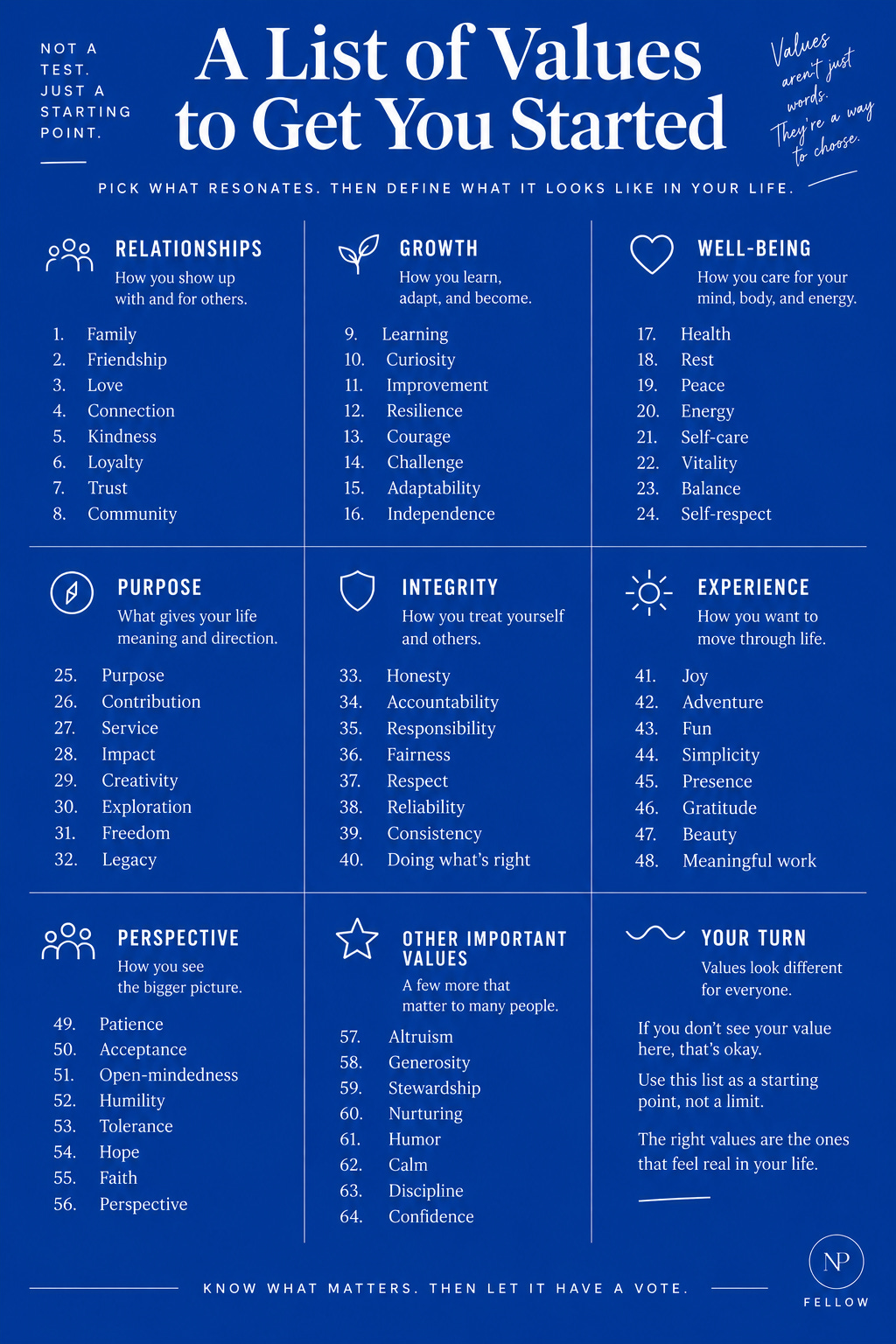
How To Use This Skill
Use three steps:
1. Choose
Instead of starting with a list of words, start with your own life.
Think about a moment when you felt genuinely good about how you handled something.
Maybe you spoke up even though you were nervous.
What mattered there? Courage.
Maybe you protected an afternoon with your kids instead of squeezing in more work. Family.
Maybe you finally made the appointment you’d been putting off. Health.
Now look at moments that left you frustrated, resentful, disappointed, or uncomfortable with yourself.
Maybe you said yes when you wanted to say no, maybe you stayed quiet about something that mattered to you, and maybe work swallowed another weekend.
Ask yourself:
What mattered to me that wasn’t getting a vote?
Frustration can tell you quite a bit about your values.
Choose three to five that matter most to you right now.
2. Define
For each value, finish this sentence:
When I’m living this value, I…
Make the answer behavioral.
Instead of:
Family
Try:
When I’m living this value, I protect time to be present with the people I love.
Instead of:
Courage
Try:
When I’m living this value, I say what I think even when I’m nervous about how it will be received.
Instead of:
Health
Try:
When I’m living this value, I make choices that help me care for my body before something goes wrong.
Now you have something you can recognize in your actual life.
3. Consult
When you’re making a decision, pause and look at the values you chose.
Ask:
Which choice gets me closer to the person I want to be?
You may still compromise and you may decide someone else’s needs matter more in that moment.
Two of your values may even pull you in opposite directions.
That’s okay.
Values give you information. You still make the choice.
When To Use This Skill
You don’t need to consult your values before deciding what toothpaste to buy.
Use this skill when you notice:
You’re about to automatically say yes.
You’re more focused on someone’s reaction than your own answer.
Two reasonable choices are pulling you in different directions.
You keep feeling resentful about the same kind of decision.
Something looks right from the outside but doesn’t feel right to you.
Those are good moments to pause.
Ask what matters before momentum answers for you.
This Week’s Practice
Don’t try to consult five values during every decision you make this week.
You’ll be exhausted by Tuesday.
→ Pick one value.
Then define it: When I’m living this value, I…
Now look for one decision this week where you can give that value a vote.
If your value is courage, maybe you share an opinion you’ve been holding back.
If it’s family, maybe you protect an evening that work keeps trying to claim.
If it’s health, maybe you go to bed when you’re tired instead of bargaining with Netflix for another episode.
If it’s curiosity, maybe you ask a question before assuming you know what someone meant.
Keep it small.
The practice is simply this: Notice the decision. Check the value. Then choose.
Signs It’s Working
This probably won’t show up as some giant moment of certainty; it’ll be quieter.
You pause before an automatic yes.
You recognize sooner when you have a preference.
You understand why a particular decision keeps bothering you.
You catch resentment before it has three weeks to marinate.
You make a choice someone else doesn’t love and still understand why you made it.
And sometimes?
→ You make the exact same choice you would have made before.
This time, you chose it.
Why This Skill Compounds Over Time
The more often you ask what matters to you, the faster you start recognizing the answer.
You catch the automatic yes earlier.
You notice resentment sooner.
You recognize when you’re chasing something because you actually want it and when you’re chasing it because you think you’re supposed to.
You also get better at noticing when your priorities have changed.
At first, that may require a deliberate pause.
→ Eventually, you start hearing yourself sooner and that matters because most of us don’t disappear from our own decisions all at once.
It happens in small moments. So does coming back.
The One-Line Reorientation
When you’re caught between what you want, what someone else wants, and what you think you’re supposed to do, ask:
→ “What matters to me here?”
You don’t have to obey the first answer that appears.
Just make sure you hear it before you choose.

Closing Reflection
You won’t consult your values before every decision.
You don’t need to.
→ Start with the moments when your own answer is about to get drowned out.
Pause long enough to notice what matters.
Maybe you still say yes.
Maybe you compromise.
Maybe you choose someone else’s needs.
Maybe you change your mind entirely.
Whatever you choose, your values got a vote, and little by little, your decisions start sounding more like yours.
Know what matters. Then let it have a vote.
Thank you for reading this article.
— Jessica
Your 2am friend who actually gets it
“The practice that is right for you will be something that you find challenging, but not overwhelming. You have to locate your own sweet spot, where the practice is hard enough that it’s helping you grow, but not so difficult that too many heavy patterns and old emotions are coming up all at once.” —Yung Pueblo
Previous Weekly Skills


NP Fellow Collective Podcast & Playlists
MEDICAL DISCLAIMER
This content is for informational and educational purposes only. It is not intended to provide medical advice or to take the place of such advice or treatment from a personal physician. All readers/viewers of this content are advised to consult their doctors or qualified health professionals regarding specific health questions. All viewers of this content, especially those taking prescription or over-the-counter medications, should consult their physicians before beginning any nutrition, supplement or lifestyle program.
🎾🍀👣💭🌞☀️🫥
Thanks Jess, lots to think about here. Just when I think I’ve matured past the little girl who was called “the diplomat” growing up I read this and realize there’s more work to be done.